Redundant Tank & Vessel Decommissioning
aking a tank or vessel out of service isn’t just a mechanical task — it’s a confined space risk problem that needs managing properly. We support the decommissioning of redundant tanks and vessels through controlled entry, cleaning, strip-out and make-safe works, leaving assets ready for the next stage: removal, repurpose, mothballing or demolition. The focus is simple: stable conditions, disciplined entry management, and a clear, documented handover.
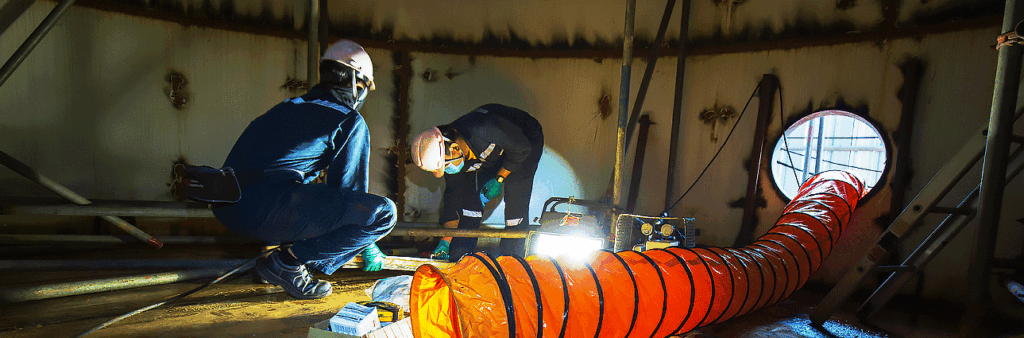
Confined space decommissioning — controlled, traceable, ready for handover.
We decommission redundant tanks and vessels in a controlled sequence: isolate, make safe, verify gas-free, clean where required, then remove internals and redundant pipework. Cut-up and removals are planned for safe handling and waste streams, leaving a tidy, documented asset ready for re-use, removal or long-term isolation.
Redundant assets often carry hidden risk. Residues sit in low points and dead legs, vapours reappear when sludge is disturbed, corrosion hides behind internals, and coatings can hold contaminants long after “empty” has been declared. A professional decommissioning sequence is about proving control at each stage — not just getting to the final cut.
We plan the works around the required end-state and the constraints of the space. That may be making the asset safe for access and inspection, cleaning and preparing it for dismantling, or supporting your programme to reach “gas-free for hot work” under the appropriate controls and competent oversight. Where internals are present (baffles, mixers, heating coils, ladders, platforms, pipework), we remove or make-safe items methodically, keeping the workfront organised and the space workable throughout.
Throughout the job we keep records that matter: entry controls, atmosphere monitoring logs where applicable, progress photographs, what has been removed, what remains, and what condition it’s in. The result is a tank or vessel that is genuinely ready for the next contractor or your own teams — with fewer surprises, fewer delays, and a close-out that stands up to review.
Typical tasks
- Pre-entry assessment: access, likely residues, hazards and workable sequence
- Support to isolation verification, lock-off and preparation for controlled entry
- Internal clean-down support and removal of sludge/residual solids (controlled handling)
- Localised decontamination in problem areas (low points, dead legs, sumps)
- Removal/strip-out of redundant internals (baffles, brackets, pipework, ladders, platforms, mixers)
- Preparation for dismantling/removal: staged make-safe, securing loose items, edge management
- Close-out documentation pack: logs/records, photos, scope completion notes and handover statement
Assets & locations
- Storage tanks (process, fuel, water, chemical — subject to site controls)
- Pressure vessels, separators and plant vessels
- Bunded areas, tank farms and pipe-rack tie-ins
- Sumps, interceptors, pits and chambers linked to vessels
- Marine tanks/voids where applicable (alongside / in yard)
- Redundant plant areas during refurbishment and shutdowns
- Awkward-access assets where internal scaffolds are impractical
Planning, permits & safety
Decommissioning is delivered under a confined space safe system of work aligned to your PTW, isolations and any hot-work restrictions. Controls are planned to keep conditions stable: verified isolations, suitable ventilation/purging strategy where required, continuous monitoring as appropriate, clear communications, and a defined stop-work threshold if conditions drift or residues are disturbed. Waste handling and contamination control are built into the method so housekeeping doesn’t degrade as the job progresses. Where other trades are working nearby, we coordinate SIMOPS, transfer routes and exclusion zones so interfaces stay controlled and the handover remains clean and defensible.
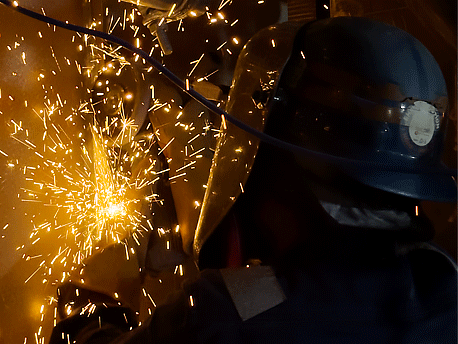
Arrange tank or vessel decommissioning support
If you have a redundant tank or vessel that needs making safe, cleaned, stripped out or prepared for removal, we can support with controlled confined space delivery and clear close-out. Provide the asset type, previous contents (where known), current status (isolated/connected), access points, end-state required, and your programme window — and we’ll come back with a practical staged approach that fits your permit controls.