Silo & Hopper Inspection Maintenance
Bulk storage assets rarely give you a clean warning before performance drops. Wear, impact damage, corrosion and product build-up develop inside the cone, outlet and transition zones — then show up as slow discharge, blockages, contamination risk or unplanned stoppages. We provide confined space inspection and targeted maintenance support inside silos, hoppers and bunkers to make internal condition known again, support safe operation, and give you clear priorities for remedial work.

Internal condition checks that support safe discharge and planned maintenance
We inspect and maintain silos, hoppers and bunkers where the defects actually live: cones, outlets, liners, seams and supports. Using confined space techniques, we can check condition, remove build-up and identify remedial actions without guesswork.
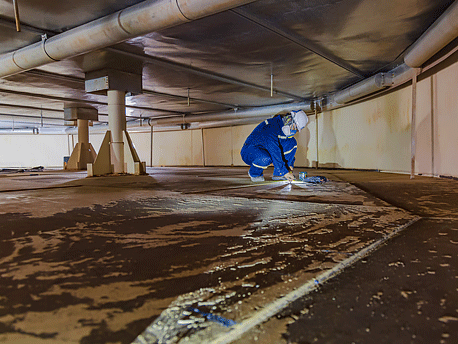
We approach each job as a confined space task first, then an inspection task. Entry is planned around contents history, isolation and entanglement risks, product hazards and any ignition risk from dust. Once controls are in place, we work through the internal zones methodically — shell plates, stiffeners, cones, transitions, outlets, discharge interfaces and wear areas — using disciplined lighting and clear defect marking so findings are repeatable. Where the scope requires, we can support thickness checks and targeted measurements to help integrity decisions and repair planning.
If maintenance is included, we support practical interventions that improve reliability without forcing a full outage scope: controlled clean-down in agreed areas, removal of loose build-up where safe and specified, securing detached items, and minor reinstatement to liners/fixtures as agreed. You receive a clear close-out: what was accessed, what was found, what was completed, and what should be programmed next.
Typical tasks
- Systematic internal visual inspection of shell, stiffeners, cone, transitions and outlet zones
- Condition checks of liners, wear plates, chutes, baffles/deflectors and impact points
- Identification of flow restrictions and build-up patterns (bridging/hang-ups) with photo records
- Support to thickness checks/measurements where required by the inspection scope
- Checks around discharge interfaces (slide gates, rotary valves, screw inlets, seals)
- Targeted clean-down / de-bulking in agreed zones (scope and method dependent)
- Minor “make-safe” and reinstatement works (as agreed): securing loose items, local liner fixes
- Pre- and post-maintenance checks for sign-off and defect tracking
Assets & locations
- Cement, lime and aggregate silos
- Grain, feed and food-process hoppers (subject to hygiene/site controls)
- Biomass, pellets and woodchip bunkers
- Coal/ash handling bunkers and transfer points
- Powder and bulk chemical storage (content and compatibility dependent)
- Quarry, asphalt and batching plant storage and loading systems
- Process hoppers, cyclones and dust-collection interfaces (as scoped)
Planning, permits & safety
All works are delivered under a confined space safe system of work aligned to your permit-to-work arrangements, isolations and site rules. Planning is centred on the real hazards of bulk storage: restricted access/egress, engulfment/asphyxiation risk from stored materials and dust, mechanical entanglement points, and ignition risk where combustible dust may be present. Controls typically include verified isolations, entry control, atmospheric testing and monitoring, ventilation where required to maintain conditions at working level, and defined emergency arrangements matched to the vessel geometry (cone angles, restricted outlets and internal obstructions). Surface controls remain tight and practical so other trades and operations can continue safely around the workfront.
Arrange a silo, hopper or bunker inspection
If you’re dealing with slow discharge, recurring blockages, unexpected product behaviour or unknown internal wear, we can support with controlled confined space inspection and practical maintenance planning. We’ll align to your permits and operating constraints, then provide clear findings and prioritised next actions that support reliable operation and sensible outage planning.