Rope Access Decommissioning Support
Decommissioning in marine environments is rarely a simple strip-out. It’s access constraints, over-water interfaces, permits, lifting plans, environmental controls and a programme that still needs the site to function. We provide rope access support for marine decommissioning works, helping teams access, isolate, remove and make-safe redundant structures and equipment efficiently, without the heavy footprint of full access builds.
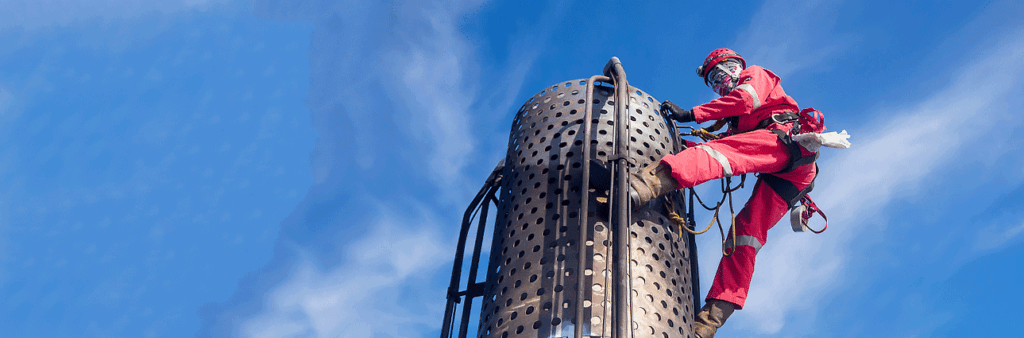
Controlled support for removal and make-safe works in marine environments.
Decommissioning rarely follows a tidy script — structures have aged, coatings are tired and what’s on the drawings doesn’t always match what’s in front of you. We provide rope access teams to reach topsides, tanks, cranes, flare structures, hull interfaces and other hard-to-reach steelwork so you can inspect, isolate, prepare and dismantle safely. Our role is to give your decommissioning contractor dependable access and practical support that keeps each phase moving while maintaining strict PTW/SIMOPS control.
Marine decommissioning work often succeeds or fails at the interfaces: awkward fixings, restricted laydown, over-water faces, congested service runs and high-level brackets that are easy to ignore until they delay the next stage. Rope access allows technicians to work directly at those interfaces, helping dismantling and removal progress in a controlled, step-by-step sequence.
We support marine decommissioning scopes by providing close access for verification checks, removal preparation, and the safe stripping-out of redundant items within the agreed method. That can include secondary steelwork, access fixtures, cable runs, brackets, guards, signage and associated fittings — plus preparation support around lifts and cut lines so rigging and lifting teams can operate efficiently. Where specialist trades are required (cutting, lifting, waste handling), we integrate our support with your permits and supervision so the job remains calm and controlled.
The output is practical: what was accessed, what was removed/made-safe, what remains, and what should be programmed next.
Typical tasks
- Access support for verification checks and interface identification (site-rule dependent)
- Removal and make-safe support for redundant secondary steelwork, brackets and fittings
- Assistance around lifts: access to connection points, obstruction removal and close-out checks (as agreed)
- Strip-out support for cable trays, small service runs and redundant fixtures (within scope)
- Access support for dismantling sequences on towers, platforms, ladders and landings (as scoped)
- Photo-backed close-out notes and defect capture for decommissioning documentation
- Final snag clearance and safe handover of remaining structures
Assets & locations
- Ports, terminals and harbour-side structures undergoing refurbishment or change
- Redundant access systems: ladders, walkways, handrails, gates and platforms
- Over-water faces where conventional access is slow or impractical
- Marine plant and dockside equipment interfaces
- Coastal structures exposed to aggressive weathering and corrosion
- Shutdown environments with multiple contractors and SIMOPS
Planning, safety & environmental control
- Marine decommissioning work is planned around permit controls, environmental constraints and live interfaces such as berth traffic, tides and simultaneous operations. Exclusion zones are set practically, tool control is disciplined, and sequencing is coordinated with lifting teams and supervisors so tasks don’t clash. Rope access is delivered as a complete system with two-rope protection and a workable rescue plan, with set-ups adjusted as workfronts move so control is maintained throughout the programme.
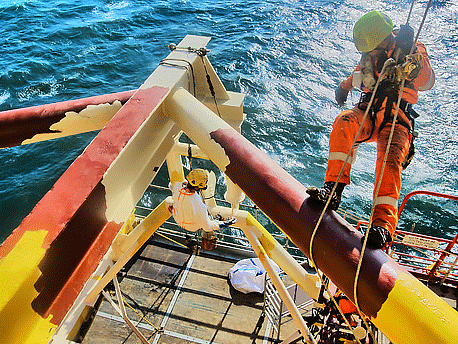
Plan marine decommissioning support
If you’re running a refurbishment or removal programme in a port or marine setting and access constraints are slowing progress, we can support with controlled rope access integrated with your permits and lift plans. Share the scope, structure type, over-water constraints, interfaces (lifting/hot work/SIMOPS) and programme window — and we’ll propose a practical support plan to help the job move cleanly.