Rope Access Building Maintenance
Buildings don’t usually fail dramatically — they drift into problems through small defects: leaking joints, loose trims, failed sealant lines, blocked outlets, minor corrosion and water tracking that spreads across façades and roof edges. We provide rope access building maintenance to keep those issues under control with close, hands-on access and minimal disruption, especially where scaffold would be disproportionate. Rope access is valued for the speed of access and the ability to work with minimal impact on other operations.
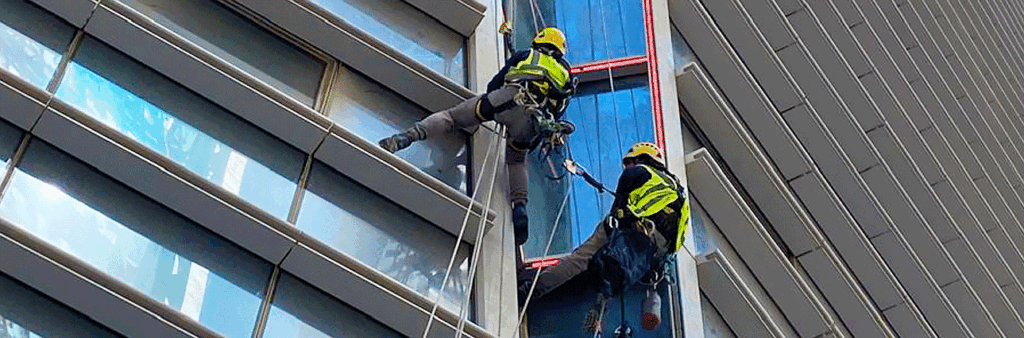
Planned maintenance at height — practical, controlled, clearly reported.
We look after the awkward parts of a building that facilities teams struggle to reach — roof edges, façades, canopies, signage, gutters and high-level details. Rope access lets us tackle local repairs, leak tracing, cleaning, minor replacements and post-storm checks quickly, with tidy documentation and minimal disruption to the people using the building.
Reactive call-outs cost more than planned maintenance because the same building details fail in the same places: edges, corners, penetrations, brackets and drainage points. Our approach is straightforward — identify the defect, agree the scope, access it safely, fix it properly, and leave a clear record of what was completed and what should be monitored next. This works particularly well for snag lists and recurring issues where access has been the barrier to getting defects closed-out.
Rope access allows technicians to work directly on the building face, under eaves lines, around canopies and on awkward setbacks where MEWPs struggle and access systems aren’t always available. The work is planned as a complete rope access operation, following IRATA’s ICOP principles (including a two-rope approach and rescue planning as part of the method), so maintenance remains controlled even when the workfront moves.
Typical tasks
- Snag-list close-out on façades, roof edges and high-level details
- Local sealing and weatherproofing around joints, penetrations and interface lines
- Minor repairs to trims, flashings, gutters/downpipes and brackets (scope-dependent)
- Make-safe works for loose components pending replacement
- Close visual checks to confirm the cause of leaks, staining or water tracking
- Local cleaning or prep to allow repairs/sealants to bond correctly
- Photo-backed close-out notes with clear defect locations and next actions
Assets & locations
- Commercial buildings, warehouses and industrial units
- Apartments, hotels and mixed-use developments
- Roof edges, parapets, soffits, canopies and recessed elevations
- Coastal properties exposed to salt, wind-driven rain and weathering
- Sites with restricted access or limited laydown space
- Façades above public areas where disruption must be kept low
Planning, access & safety
All work is planned, supervised and delivered under a safe system of work with practical protection below, clear exclusion zones and disciplined tool control. HSE guidance is clear that work at height must be properly planned and supervised. Rope access is treated as a complete system with two-rope protection and a site-specific rescue plan, in line with IRATA ICOP principles. The outcome is a controlled job on the day — and a close-out record that supports your maintenance file.
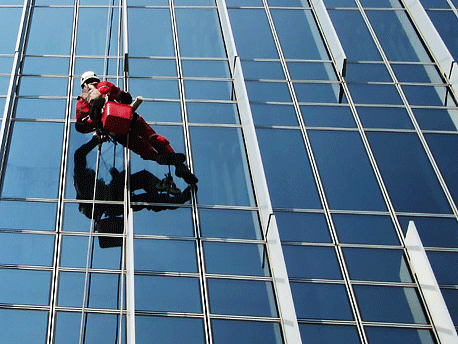
Arrange rope access building maintenance
If you’ve got repeat defects, a snag list to close, or high-level maintenance that’s been delayed by access constraints, we can support with a controlled rope access approach. We’ll agree scope and priorities up front, plan around your operating hours and site interfaces, and provide a clear close-out showing what was addressed and what should be programmed next.